

In 2026, the digital landscape has shifted from “assistive AI” that waits for instructions to “agentic AI” that takes action independently. For a forward-thinking marketing agency like Talencee in Gurgaon, leveraging these autonomous teammates is how we complete high-impact tasks 1.8x faster than the traditional competition.
This guide breaks down the Top 5 AI Agents that are redefining efficiency in 2026. From autonomous researchers to CRM-integrated executors, these tools are the new standard for building scalable, high-performance business systems.
1. OpenAI Operator (The Multimodal Executor)
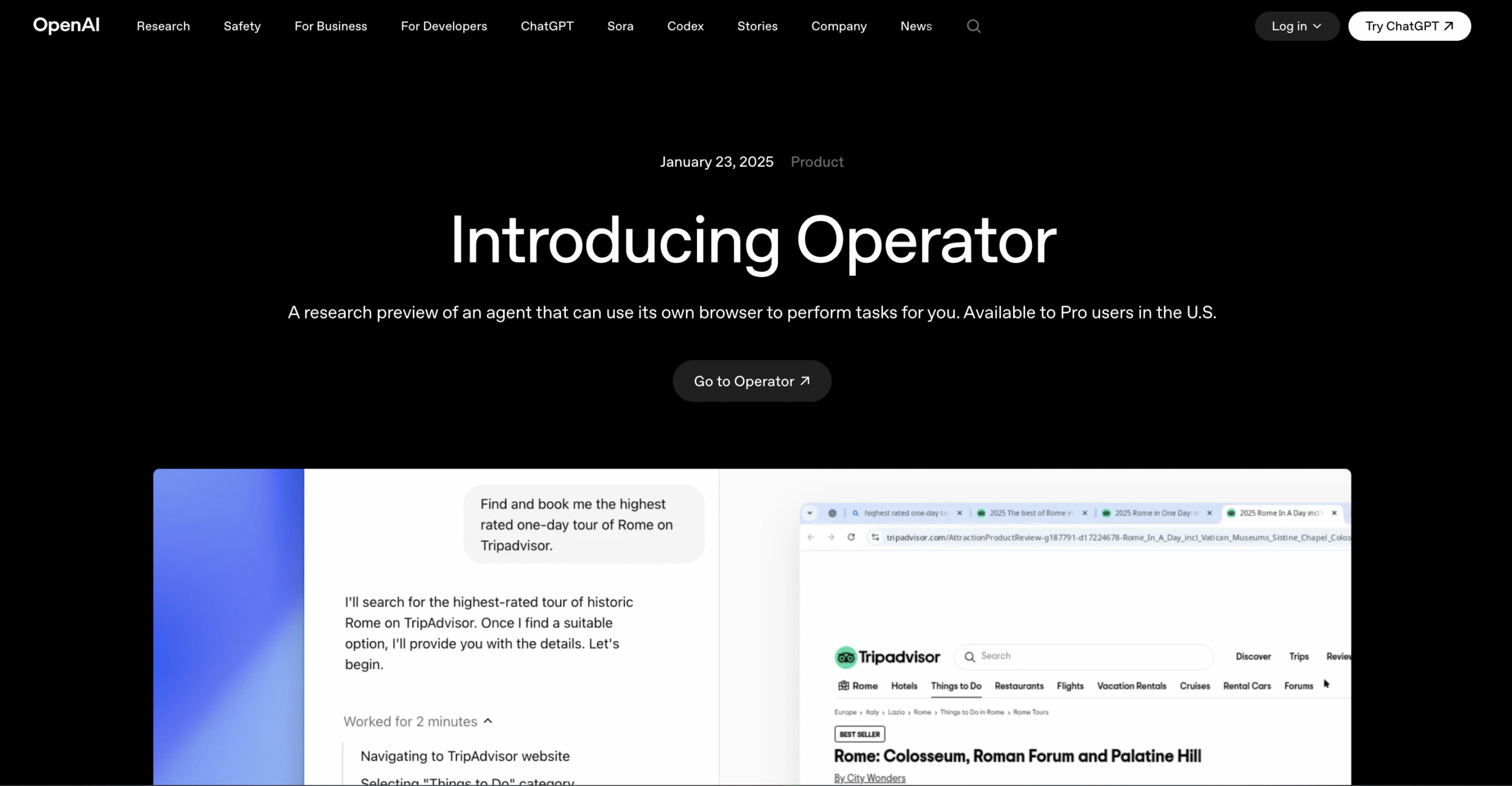
Best For: Autonomous Cross-App Task Execution
The OpenAI Operator represents the next generation of autonomy. Unlike standard chatbots, it doesn’t just draft a plan; it navigates software interfaces to execute it.
- Brief Overview: It can autonomously handle multi-step tasks across different apps, such as booking complex travel using reward points or conducting deep market research and scheduling viewings in a calendar.
- Key Benefit: It frees users from micromanaging every step of a digital process, allowing you to provide a high-level goal while the agent handles the clicks and navigation.
2. Zapier Central (The No-Code Orchestrator)
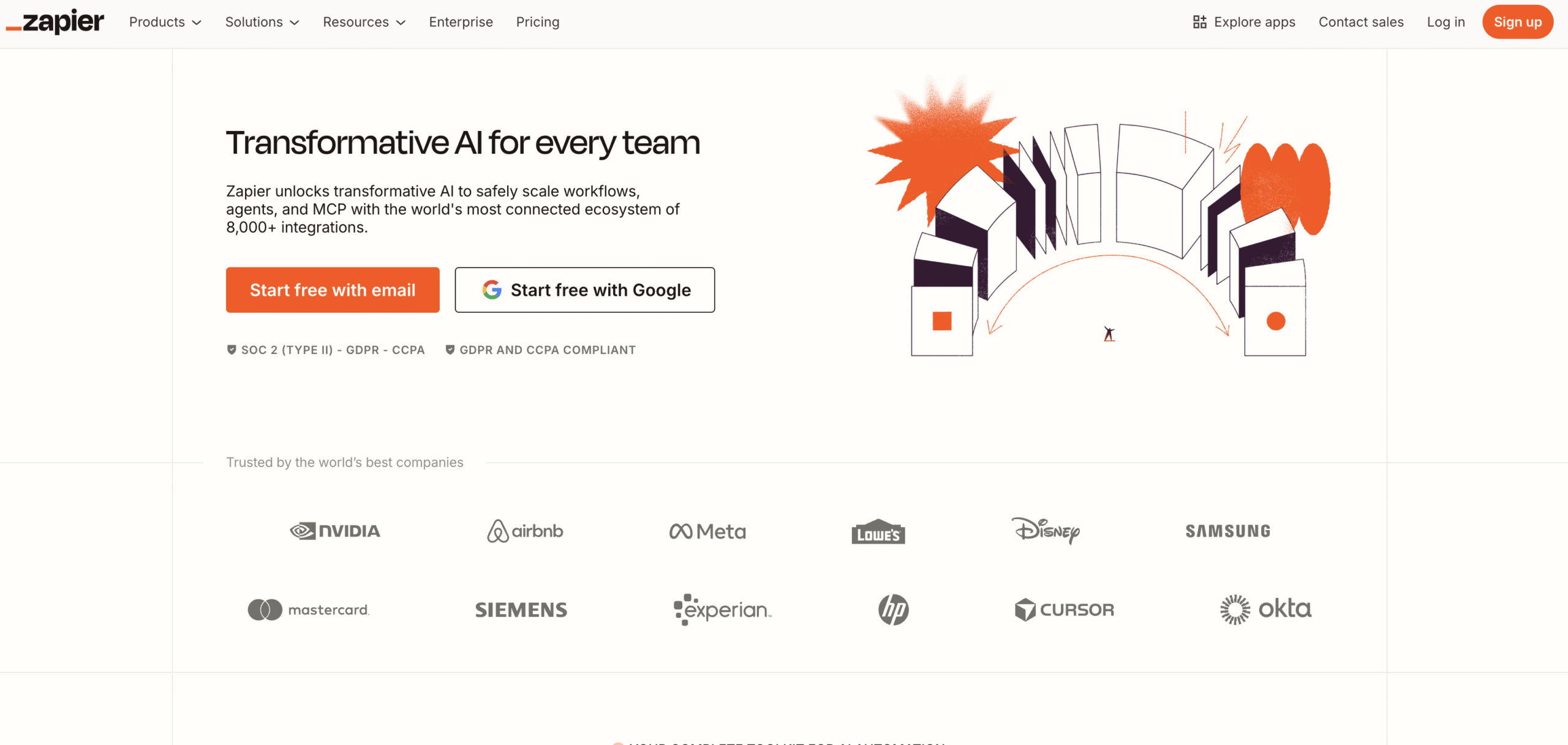
Best For: Connecting AI to 8,000+ Business Apps
Zapier Central is the hub where your favorite apps meet autonomous intelligence. It allows you to build custom AI agents that interact with your entire tech stack without writing a single line of code.
- Brief Overview: You can define a goal, like “summarize new leads from HubSpot and draft a Slack update”, and Zapier’s AI Copilot builds the workflow, connects the accounts, and tests each step.
- Key Benefit: It transforms static automations into “intelligent teammates” that can react to real-time triggers and make context-aware decisions.
3. n8n (The Enterprise Logic Engine)
Best For: Complex, Self-Hosted Multi-Agent Workflows
For agencies and enterprises needing deep technical control, n8n is the premier choice. It is a source-available platform that excels at handling complex, multi-step reasoning and tool-chaining.
- Brief Overview: It allows developers to chain together actions, memory, and specialized tools to create “Agentic AI workflows”. It supports multi-model integration, meaning you can use Gemini, Claude, and GPT-4 in the same workflow.
- Key Benefit: It provides the “operating system” for agentic workflows, enabling businesses to translate complex logic into production-ready, autonomous systems with precision.
4. Fireflies.ai (The Intelligent Meeting Agent)
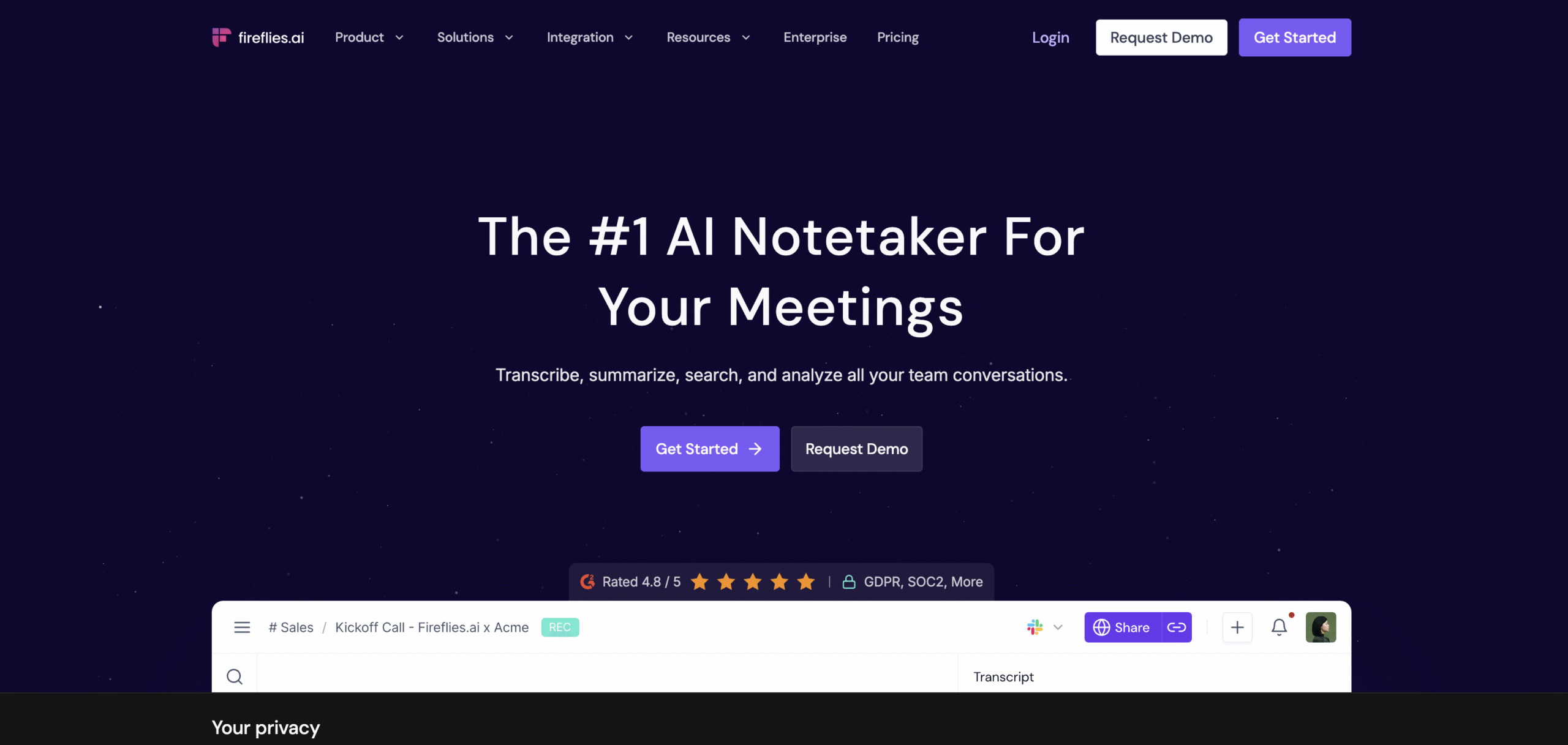
Best For: Meeting Memory and CRM Automation
Meetings are no longer “lost time” thanks to Fireflies.ai. This agent acts as a persistent memory for your organization, transcribing and analyzing every call.
- Brief Overview: Beyond transcription, it extracts action items and automatically updates CRM systems like Salesforce or HubSpot. It allows you to “ask” your meetings questions, like “What was the client’s main concern about the Q1 budget?”.
- Key Benefit: It eliminates the manual work of meeting notes and CRM entry, ensuring that every strategic discussion is documented and searchable.
5. CrewAI (The Multi-Agent Manager)
Best For: Orchestrating Specialized AI Teams
CrewAI is designed for businesses that need a “crew” of specialized agents working together. It allows you to assign specific roles, like a Researcher, Writer, and Strategist—to work as a coordinated team.
- Brief Overview: It features a central orchestrator that manages multi-agent workflows, similar to a project manager. It is ideal for high-volume content creation, lead generation, and business reporting.
- Key Benefit: It simplifies the process of building an “AI workforce” where different agents handle different parts of a complex goal, ensuring each step is handled by a specialist.
Why Early Adoption is the “Talencee Way”
By 2026, Gartner predicts that 40% of enterprise applications will embed task-specific AI agents. Companies that adopt these systems early aren’t just saving time; they are reshaping their entire operational structure to be faster, more accurate, and more scalable.
At Talencee, we don’t just use these tools; we integrate them into our DNA to ensure that our Gurgaon-based clients get results that are both strategically brilliant and delivered at the speed of 2026.
Frequently Asked Questions (FAQs)
- What is the fundamental difference between an AI tool and an AI agent?
An AI tool is reactive, it requires a human command to perform a single task. An AI agent is proactive and goal-oriented; it can plan its own steps, make decisions, and use external tools to achieve a broad objective without constant human oversight. - Can AI agents really be trusted to handle sensitive business data?
While agents are highly efficient, they lack “contextual judgment” out-of-the-box. In 2026, trust is built through “Agentic RBAC” (Role-Based Access Control), which strictly limits what data an agent can see and where it can send that information, ensuring it stays within approved boundaries. - Do I need to be a developer to build an AI “Crew”?
No. Frameworks like CrewAI and Zapier Central offer “no-code speed”. You can define an agent’s role, goal, and “backstory” using natural language (YAML or simple text), allowing marketing leads to orchestrate complex teams of AI researchers and writers without writing code. - How do agents like “OpenAI Operator” interact with other websites?
They use specialized “Computer-Using Agents” (CUA). These agents can “see” a website’s interface, plan a chain of thought, and then perform human-like actions such as clicking, typing, and scrolling to complete tasks like booking a reservation or scraping competitor data. - What happens if an AI agent makes a mistake or “hallucinates”?
Robust frameworks implement “feedback loops”. When an agent completes a task, its output is often evaluated by a separate “evaluator agent” or a human-in-the-loop (HITL) checkpoint to verify factual accuracy and logical consistency before the action is finalized. - Is it better to have one “super agent” or multiple specialized agents?
The 2026 industry standard is a Multi-Agent System. Similar to a real-life work crew, specialized agents (e.g., one for research, one for legal review, one for writing) are more accurate and easier to monitor than a single agent trying to handle everything. - Can AI agents help with regulatory compliance in the UAE?
Yes. For firms like Finnect, agents can be programmed to monitor transactions for AML (Anti-Money Laundering) patterns, reconcile tasks automatically, and flag transactions that cross predefined compliance thresholds in real-time. - How do AI agents impact my agency’s ROI?
In marketing, AI-driven campaign targeting is seeing 25% higher engagement rates, while customer support agents are resolving queries 40% faster. Agencies adopting these “agentic” models are outperforming traditional competitors by scaling services without a linear increase in costs. - What are the biggest security risks for agents in 2026?
The most common risks include excessive permissions (giving an agent more access than it needs) and prompt injection, where a malicious email or document tricks the agent into leaking data or performing unauthorized actions. - How should a business start implementing AI agents?
The best path is to start with “semi-autonomous” agents. Identify a process that is repetitive and error-prone,like lead qualification or daily reporting, and deploy an agent with clear “escalation rules” so it knows exactly when to ask a human for help.