

As digital marketing enters its next phase, 2026 is shaping up to be a defining year for how brands compete, communicate, and grow. The rapid adoption of Artificial Intelligence over the past few years has laid the foundation for a more intelligent, predictive, and experience-driven marketing ecosystem.
In 2026, success in digital marketing will no longer depend on how loudly a brand speaks, but on how intelligently it listens, adapts, and responds. AI will move from being a competitive advantage to an operational standard, and brands that fail to align with this reality will struggle to maintain relevance.
This is what digital marketing is expected to look like in 2026 and what brands should begin preparing for now.
AI Will Be the Core Operating System of Marketing
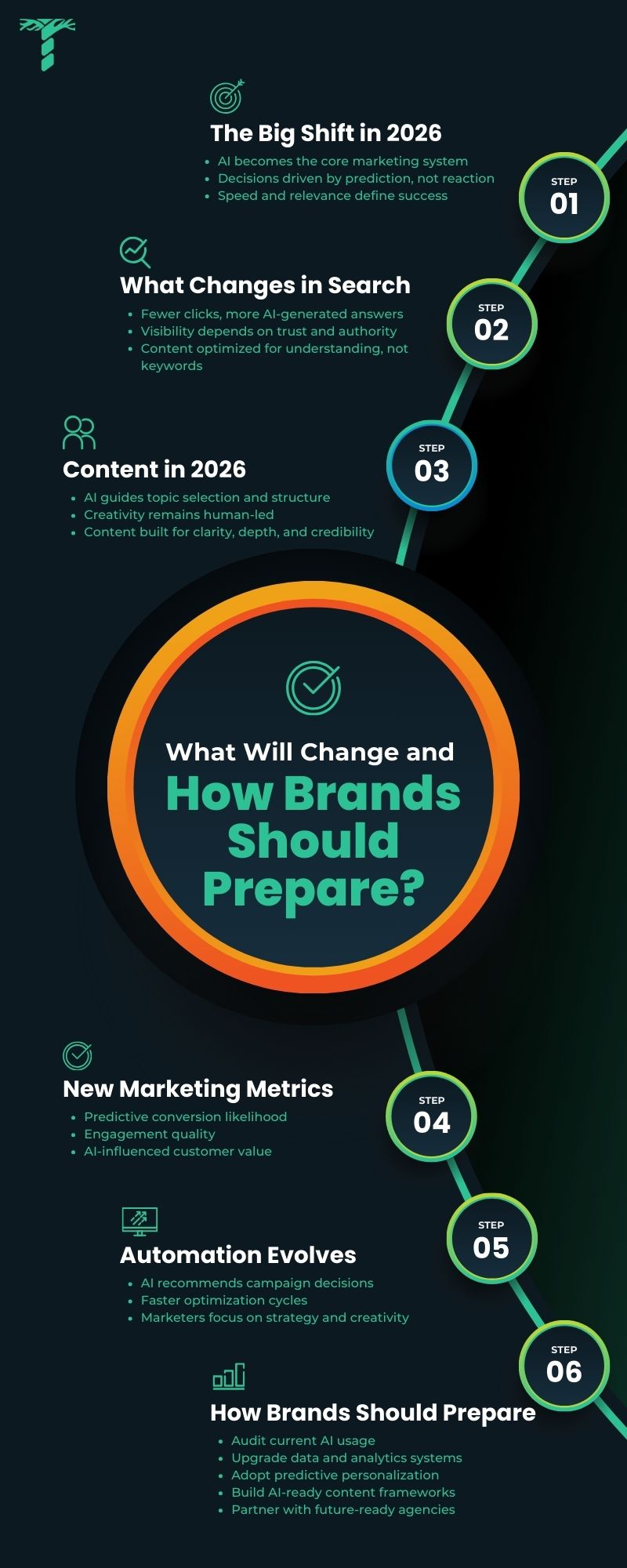
By 2026, AI will no longer function as a supporting tool. It will act as the central operating system behind most marketing decisions. From campaign planning to execution and optimization, AI will drive strategy at every level.
Marketing teams will rely on AI to analyze complex datasets, forecast outcomes, and recommend actions in real time. Decisions that once took weeks of analysis will be made instantly, supported by predictive intelligence rather than assumptions.
Brands that integrate AI deeply into their workflows will move faster, allocate budgets more effectively, and respond to market changes with greater precision.
Search Will Become Answer-Based, Not Click-Based
Search behavior will continue to evolve beyond traditional keyword-based queries. In 2026, users will increasingly rely on AI-powered systems that provide direct answers, summaries, and recommendations rather than lists of links.
This shift will significantly reduce the importance of rankings alone. Visibility will depend on how well content is understood, trusted, and selected by AI-driven platforms. Brands will need to focus on clarity, authority, and contextual depth rather than volume-driven content strategies.
Search optimization in 2026 will prioritize expertise, structured information, and real-world relevance. Content that demonstrates clear value and credibility will outperform content designed only for algorithms.
Content Will Be Designed for Intelligence, Not Just Audiences
In 2026, content strategies will be shaped as much for AI systems as for human readers. This does not mean content will become robotic. It means content will need to be precise, well-structured, and strategically aligned with user intent.
AI will assist with topic modeling, content forecasting, and performance prediction before publication. This will reduce wasted effort and allow brands to invest in content that delivers measurable impact.
Human creativity will remain essential, but AI will guide where creativity is applied for maximum effectiveness. The most successful brands will combine strong storytelling with data-backed insight.
Personalization Will Become Predictive and Proactive
Personalization in 2026 will move beyond reacting to user behavior. It will become predictive and proactive. AI will anticipate needs before users explicitly express them.
Websites will adapt content dynamically based on intent signals. Campaigns will adjust messaging in real time. Customer journeys will feel seamless and intuitive rather than segmented across channels.
Consumers will expect experiences that feel relevant without being intrusive. Brands that achieve this balance will earn trust and loyalty. Those that rely on generic messaging will see engagement decline.
Marketing Metrics Will Be Redefined
Traditional performance metrics will continue to lose relevance as AI-driven ecosystems grow. In 2026, success will be measured by influence and intelligence rather than isolated actions.
Key metrics will include AI visibility, predictive conversion likelihood, engagement quality, and long-term customer value influenced by AI-driven touchpoints.
Marketing leaders will focus less on surface-level performance and more on how effectively their brand influences decision-making across intelligent platforms.
Automation Will Shift Toward Strategic Enablement
Automation in 2026 will not be limited to scheduling or task execution. It will support strategic enablement. AI systems will recommend campaign adjustments, creative variations, and audience shifts based on live data.
Marketers will move into roles that emphasize oversight, creativity, and strategic thinking. Execution-heavy tasks will increasingly be handled by intelligent systems.
This shift will require new skill sets and a stronger understanding of how to work alongside AI rather than compete with it.
The Role of Digital Marketing Agencies Will Evolve
As marketing complexity increases, the role of digital marketing agencies will become more strategic than ever. Agencies will act as intelligence partners, not just execution vendors.
In 2026, agencies will help brands navigate AI adoption, align technology with business goals, and maintain brand integrity in an automated environment. Strategy, governance, and performance accountability will define agency value.
Brands will seek partners who understand both technology and human behavior and who can translate intelligence into sustainable growth.
What Brands Should Do Today to Prepare for 2026
Preparation for 2026 begins now. Brands should start by auditing their current use of AI, data infrastructure, and personalization capabilities. Incremental adoption of AI-driven segmentation, predictive analytics, and content intelligence can deliver immediate value while building long-term readiness.
Equally important is investing in skills, strategy, and partnerships that support intelligent marketing operations. The goal is not to adopt every new tool, but to build a system that evolves with the market.
Conclusion
Digital marketing in 2026 will favor brands that think ahead, act intelligently, and adapt continuously. AI will not replace marketers, but it will redefine what effective marketing looks like.
Brands that embrace intelligence-driven strategies will grow faster, build stronger relationships, and operate with greater efficiency. Those that resist change will find it increasingly difficult to compete.
The future of digital marketing is not about more noise. It is about better decisions. The brands that understand this today will lead in 2026.