
Benefits, Challenges, and Real-World Cost Considerations
Forward-thinking marketers are increasingly integrating artificial intelligence into their SEO workflows and seeing measurable improvements in efficiency, scalability, and decision-making. AI is no longer experimental. It is becoming a core operational layer in modern search optimization.
This article explores how AI is being used across SEO today, including ten practical use cases, key benefits, common challenges, and realistic cost considerations. The goal is to provide a research-driven, platform-neutral framework for understanding where AI adds value and where human expertise remains essential.
What Is AI SEO?
AI SEO refers to the use of artificial intelligence, machine learning, and large language models to automate, enhance, and scale search engine optimization activities. Instead of relying solely on manual research, analysis, and optimization, AI systems can process large datasets, detect patterns, and generate insights at speeds that far exceed human capacity.
AI-powered SEO tools use natural language processing to understand search intent, evaluate competitor content, and assist in drafting and optimizing web pages. This enables faster workflows, deeper analysis, and more consistent execution.
At its core, AI SEO is not about replacing SEO professionals. It is about augmenting human strategy with computational intelligence, allowing teams to move from reactive optimization to proactive, data-driven decision-making.
Core Applications of AI in SEO
AI impacts SEO across four major areas:
Automation of repetitive tasks
AI handles time-intensive activities such as keyword discovery, metadata generation, and large-scale content audits. This reduces manual workload and allows teams to focus on strategy and creative execution.
Advanced data analysis
Machine learning systems analyze massive datasets related to rankings, user behavior, and content performance. They identify correlations and patterns that would be difficult to detect manually.
Content optimization
AI evaluates existing content against top-ranking pages and suggests improvements related to structure, coverage, semantic relevance, and readability.
Predictive insights
Advanced models can estimate ranking potential, forecast traffic trends, and identify which content strategies are most likely to succeed based on historical and real-time data.
The strategic advantage is not just speed. It is the ability to make evidence-based decisions at scale, supported by large volumes of search and performance data.
Key Benefits of Using AI for SEO
Increased Efficiency
AI significantly reduces the time required for research, analysis, and content preparation. Tasks that previously took hours can often be completed in minutes. This allows teams to execute more initiatives and test more strategies within the same resource constraints.
Scalability
AI removes traditional bottlenecks. Small teams can analyze thousands of keywords, audit hundreds of pages, and create multiple content briefs simultaneously. This levels the playing field between smaller organizations and larger competitors.
Deeper Data Insights
AI excels at pattern recognition. It can surface emerging trends, identify content gaps, and detect correlations between ranking factors that are difficult to spot manually.
Consistency in Optimization
AI applies the same optimization logic across all pages. This reduces variability in quality and ensures that baseline SEO best practices are applied consistently across large content libraries.
Cost Efficiency
While AI tools require investment, they are often more cost-effective than hiring additional staff to perform equivalent workloads. The productivity gains typically justify the subscription costs for most growing teams.
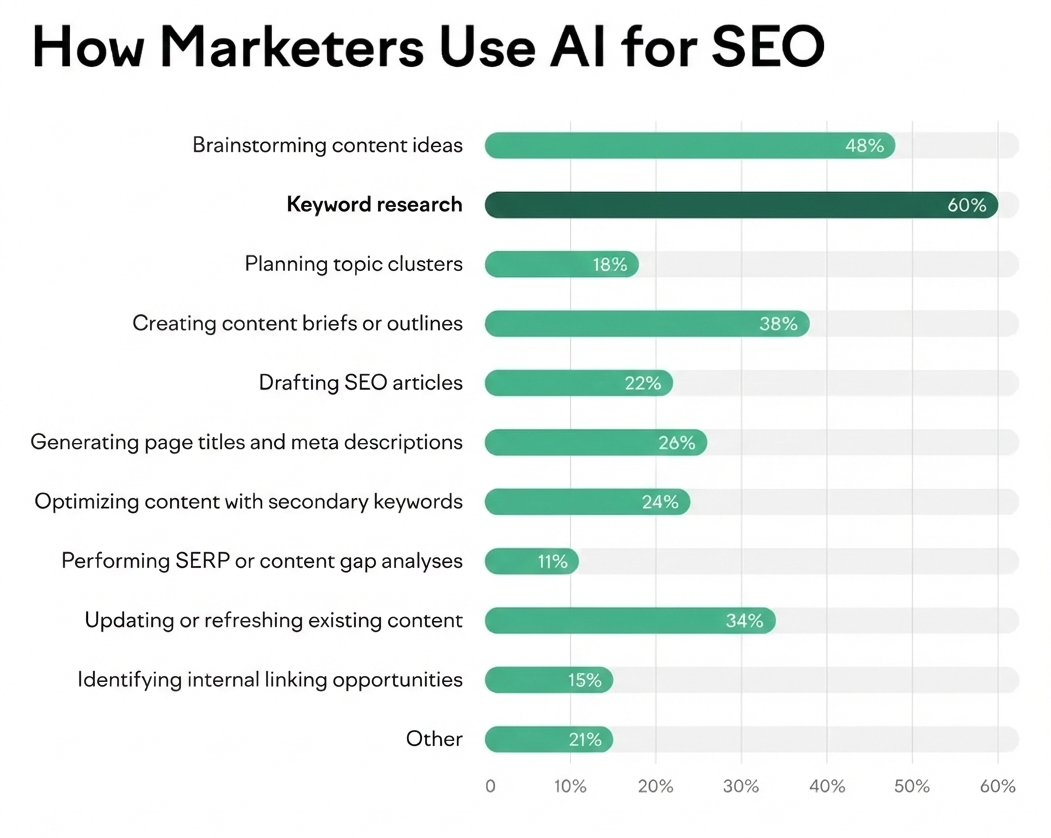
How Marketers Are Using AI in Practice
Research into real-world usage shows that AI is primarily used to support planning and optimization rather than fully automate content creation.
The most common use cases include:
-
Keyword research
-
Content idea generation
-
Content brief and outline creation
-
Updating and refreshing existing content
-
Generating title tags and meta descriptions
-
Identifying internal linking opportunities
Notably, fewer marketers rely on AI to publish final long-form content without human editing. This reflects the understanding that high-quality, authoritative content still requires human review and refinement.
10 Practical Ways to Use AI for SEO
1. Brainstorm Content Ideas
AI is effective at generating topic ideas tailored to specific audiences, industries, and funnel stages. With detailed prompts, teams can quickly produce structured content calendars and identify bottom-of-funnel opportunities.
Limitation: AI cannot reliably determine actual search demand without integration with real keyword data.
2. Conduct Keyword Research
AI can generate long-tail keyword ideas, question-based searches, and purchase-intent phrases. This is useful for early-stage ideation and expanding seed keyword lists.
However, AI alone does not provide accurate search volume, competition, or ranking difficulty metrics. These still require specialized data sources.
3. Plan Topic Clusters
AI helps organize keywords into logical topic clusters, including pillar pages and supporting subpages. This improves site structure, internal linking, and topical authority.
4. Perform SERP Analysis
AI can summarize what top-ranking pages cover, identify common themes, and highlight content gaps. This speeds up competitive analysis and helps teams design content that is more comprehensive and differentiated.
5. Draft Content
AI can generate structured first drafts based on outlines and prompts. This accelerates content production but should be treated as a starting point, not final output.
Human editing is essential to ensure accuracy, originality, and alignment with brand voice.
6. Generate FAQs
AI is highly effective at creating FAQ sections that target question-based queries. This improves content depth and supports visibility in features like People Also Ask and featured snippets.
7. Optimize with Secondary Keywords
AI can insert or recommend placements for semantically related terms. This improves topical relevance and allows pages to rank for a wider set of related queries.
8. Generate Title Tags and Meta Descriptions
AI can produce multiple SEO-friendly variations of titles and meta descriptions, allowing teams to test messaging and improve click-through rates.
9. Improve Internal Linking
AI can analyze content and suggest relevant internal link opportunities. This strengthens site architecture, improves crawlability, and distributes link equity more effectively.
10. Refresh Existing Content
AI can compare existing pages to current top-ranking competitors and recommend updates. This is especially valuable for pages that rank on page two or have recently declined in performance.
Challenges and Risks of AI SEO
Despite its advantages, AI introduces several risks:
Content quality concerns: AI-generated content can be generic and lack unique insight or perspective.
Accuracy issues: AI may produce incorrect information with high confidence. Fact-checking is essential.
Over-automation: Relying too heavily on AI can result in shallow, low-value content.
Brand voice dilution: Without careful editing, AI outputs can sound generic and inconsistent with brand identity.
Search engine policy alignment: Search engines prioritize helpful, original content. AI-generated content that lacks depth or originality may underperform.
Best Practices for Using AI Effectively
-
Use AI for research and drafting, not final publishing
-
Always fact-check and validate AI outputs
-
Maintain strong human editorial oversight
-
Train AI prompts with brand voice guidelines
-
Add unique value such as original insights, data, and case examples
-
Focus on experience, expertise, and trust signals
The most successful teams use AI as a productivity multiplier, not a replacement for strategic thinking and subject matter expertise.
AI SEO Cost Considerations
Pricing for AI SEO tools varies based on capability, usage limits, and data access.
Typical pricing tiers:
Basic plans: approximately $50 to $150 per month
Professional plans: approximately $150 to $300 per month
Enterprise plans: $300 per month and above
Costs depend on:
-
Depth of features
-
Data access and competitive intelligence
-
Usage limits
-
Number of team members
When evaluating ROI, organizations should consider time savings, increased output, and reduced dependency on manual labor. In many cases, the productivity gains alone justify the investment.
The Strategic Role of AI in Modern SEO
AI is now a foundational component of competitive SEO. It enhances research, accelerates content planning, improves optimization, and supports data-driven decision-making at scale.
However, AI does not replace human judgment, creativity, or expertise. The most effective SEO strategies combine AI’s speed and analytical power with human insight, editorial control, and strategic direction.
Organizations that strike this balance are best positioned to compete in an increasingly complex and AI-influenced search landscape.